Today marks an important milestone for us at Vismrit Tech.
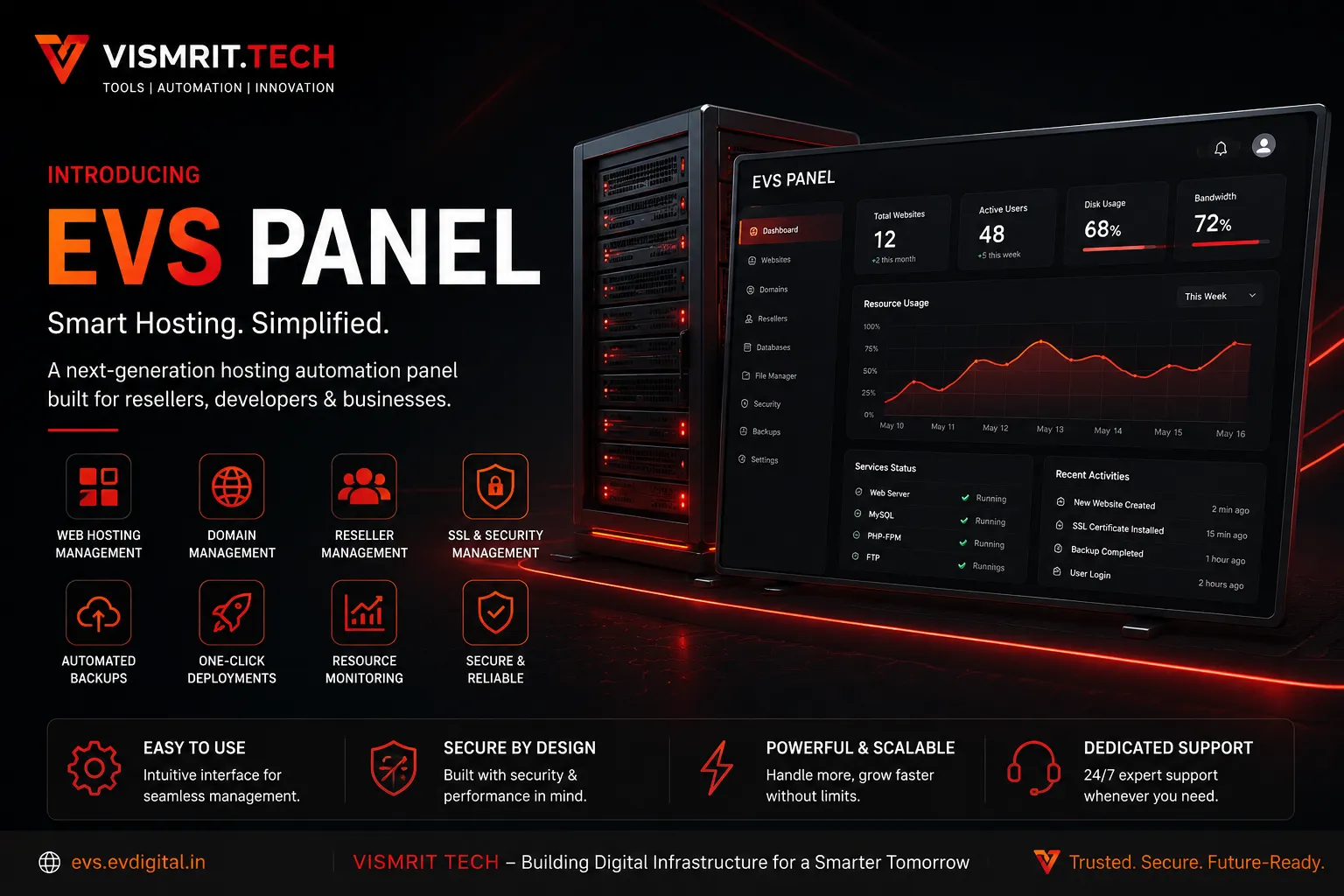
We are proud to officially introduce EVS Panel, our modern hosting and server management control panel designed to give developers, agencies, hosting providers, resellers and technical teams greater control over their infrastructure.
EVS Panel started from a problem we repeatedly encountered while operating servers and deploying real applications: modern hosting has changed dramatically, but many hosting control panels still revolve around workflows created primarily for traditional PHP shared hosting.
Applications today may combine PHP, Node.js, Python, databases, Redis, object storage, background workers, SSL, APIs, tunnels and multiple web-server technologies.
EVS Panel is being built for this environment.
Rather than hiding the server behind an oversized abstraction layer, EVS Panel aims to provide a clear management interface while keeping the underlying infrastructure visible and controllable.
What Is EVS Panel?
EVS Panel is a modern hosting control panel focused on Ubuntu-based infrastructure.
It brings websites, applications, databases, SSL certificates, backups, users, resellers, files, terminal access and server services together into one management environment.
The platform combines a graphical interface with command-line control and an API-ready architecture so administrators can choose the workflow that fits the task.
The current EVS Panel product is available at:
Why We Built EVS Panel
Cloud servers have become incredibly accessible.
Within minutes, almost anyone can provision an Ubuntu VPS with significant computing power. But actually turning that server into a secure, maintainable hosting environment remains considerably more complicated.
A production server may require:
- Web-server configuration
- PHP runtime configuration
- Node.js or Python application management
- Database provisioning
- SSL certificate management
- Backups
- User permissions
- Storage management
- Security controls
- Monitoring
- Worker and process management
- File access
- Terminal access
These technologies are powerful individually, but managing all of them manually creates repetitive work and increases the possibility of configuration mistakes.
EVS Panel exists to bring those moving pieces into a consistent operating environment.
Designed for Ubuntu Infrastructure
EVS Panel currently focuses on Ubuntu servers.
This is intentional.
Instead of attempting to support every Linux distribution from the first release, we chose to concentrate development around a predictable server platform where installation, services, permissions and package behaviour can be tested consistently.
This allows us to build a more controlled installation and management experience.
Website Management
Website management is one of the central components of EVS Panel.
Administrators can organize domains, subdomains and hosting configurations from a single workspace.
The objective is to make routine website administration fast while maintaining enough visibility for technical users to understand how a website is actually being served.
Multiple Web Servers
Different applications have different requirements, which is why EVS Panel is being designed around more than one serving technology.
The current architecture includes support for:
- Nginx
- Apache
- OpenLiteSpeed
- Per-site configuration
This allows administrators to select an appropriate web-server stack rather than forcing every workload into one predefined configuration.
Multiple PHP Versions
Hosting multiple PHP applications often means dealing with different framework and runtime requirements.
EVS Panel provides PHP version management so compatible runtimes can be assigned to different applications while extensions and related configuration remain manageable from a central interface.
This is particularly useful for agencies and hosting environments where older applications and modern applications need to operate on the same infrastructure.
Node.js and Python Applications
EVS Panel is not intended to remain limited to traditional PHP hosting.
Modern application architecture increasingly relies on Node.js and Python for APIs, real-time systems, AI services, automation workers, background processing and application backends.
Node.js and Python application controls are currently part of the developing EVS architecture, with runtime and worker-oriented management being expanded as the platform matures.
Database Management
A hosting panel should provide more than a MySQL database creation form.
Modern infrastructure often uses several different data services depending on the workload.
EVS Panel architecture currently brings together technologies including:
- MariaDB
- MySQL
- MongoDB
- Redis
- MinIO
The intention is to let administrators provision and organize commonly used database and data services through consistent workflows.
SSL Automation
HTTPS security should be part of normal deployment rather than a separate maintenance burden.
EVS Panel provides workflows for issuing, inspecting and renewing SSL certificates while maintaining visibility over domain security.
This is designed to reduce the repetitive work involved in certificate lifecycle management and make SSL status easier to identify before it becomes a production problem.
Backup Management
A server management platform is incomplete without a reliable backup workflow.
EVS Panel includes backup management designed around creating, scheduling and restoring local or remote backups.
The long-term objective is to make backup status as visible as website or service status so administrators know whether recoverable copies of important data actually exist.
File Manager and Web Terminal
Graphical controls are useful, but developers sometimes need direct access.
EVS Panel therefore includes both a file manager and a web terminal.
This lets administrators move from a website or application configuration directly into files or command-line work without losing context.
The platform is designed to complement Linux administration rather than completely hide it.
Server Monitoring
Managing infrastructure effectively requires knowing what the server is doing.
EVS Panel surfaces important operational information including:
- CPU utilisation
- Memory utilisation
- Storage utilisation
- Service health
- Recent system activity
- Infrastructure status
Monitoring features are intended to provide the context required to investigate issues before moving into deeper command-line diagnosis.
Administrator, Reseller and User Roles
Hosting infrastructure is rarely managed by only one type of account.
EVS Panel is being designed around clear responsibility boundaries.
Administrator
The administrator controls servers, infrastructure services, global settings, users, resellers and system-wide configuration.
Reseller
Resellers can manage customer accounts and distribute resources according to assigned limits and quotas.
User
Users receive a focused workspace for managing the websites, applications, databases, files, SSL certificates and backups assigned to their account.
This structure allows EVS Panel to serve individual businesses while also supporting agencies and hosting providers.
Command-Line Control with evsctl
One of the principles behind EVS Panel is that automation should not stop at the graphical interface.
The evsctl control utility provides command-line access to important panel and server operations.
This makes it possible for infrastructure tasks to be scripted, automated or integrated into administrative workflows.
For developers and system administrators, this creates a bridge between the convenience of a hosting panel and the flexibility of conventional server management.
API-Ready Architecture
EVS Panel is being designed with APIs as part of the architecture rather than as an afterthought.
An API-ready platform enables future integrations with billing systems, automation platforms, provisioning systems, internal business software and third-party tools.
For hosting providers, this is especially important because server management eventually needs to integrate with customer onboarding, subscriptions, provisioning and lifecycle automation.
Secure Tunnel Management
EVS Panel is also developing integrated secure tunnel management based around FRP connectivity.
The goal is to allow server and client tunnel modes to be configured while administrators assign appropriate routes and ports to users.
This functionality is currently considered part of the developing and beta feature set.
Email Infrastructure
Email hosting is planned as another major EVS Panel capability.
The architecture is being designed around common open-source mail components including:
- Postfix
- Dovecot
- Rspamd
- SOGo
- Redis
- ClamAV
The objective is to eventually bring mailbox creation, mail security and related administration into the same environment as websites and server infrastructure.
Object Storage with MinIO
Modern applications increasingly use object storage rather than relying only on conventional filesystem storage.
MinIO management is part of the planned EVS Panel architecture, with the goal of managing connections, buckets, access policies, privacy settings and quotas through the panel.
EVS Panel Version 1.2.0
The Vismrit licensing platform currently lists EVS Panel version 1.2.0.
EVS Panel is actively evolving, and several sections of the broader product architecture remain in development, beta or planned status.
We believe showing this clearly is important. EVS Panel is being built iteratively rather than presenting unfinished functionality as complete.
EVS Panel Professional Licence
EVS Panel is distributed through the Vismrit software licensing platform.
The currently active Professional plan is:
- Price: ₹1,000
- Duration: 365 days
- Installations: 1
- Administrator accounts: Up to 5
- Reseller accounts: Up to 50
- User accounts: Up to 1,000
- Websites: Up to 5,000
- Databases: Up to 5,000
- Email accounts: Up to 10,000
- Storage allowance: Up to 5,000 GB according to the current licence configuration
The current Professional entitlement also includes access flags for website management, MongoDB management, backup management, email management, reseller management, terminal access, API access and automatic updates.
Plan features and limits are controlled through the Vismrit licensing platform and may evolve as EVS Panel development progresses.
A Licence Connected to the Vismrit Customer Workspace
EVS Panel licences remain connected to the Vismrit customer account throughout their lifecycle.
The process is designed around four stages:
- Purchase or activate the appropriate plan.
- Licence issuance after verified payment or fulfilment.
- Install and verify EVS Panel according to the plan rules.
- Manage the lifecycle including status, expiry, installations and access from the Vismrit dashboard.
This allows software purchase, activation and ongoing entitlement management to remain within the same ecosystem.
Built for Developers, Agencies and Hosting Providers
EVS Panel is being developed for more than one type of user.
Potential use cases include:
- Developers managing personal infrastructure
- Agencies hosting customer applications
- SaaS businesses operating multiple services
- Hosting providers managing customer environments
- Resellers distributing hosting resources
- Internal IT teams managing company applications
- Developers running PHP, Node.js and Python workloads together
Not Another Black Box
One of our most important design goals is avoiding the idea that a control panel should completely hide the server.
Abstraction is useful until something fails.
When that happens, administrators need to understand what is running, where configuration exists and how services interact.
EVS Panel therefore aims to simplify routine operations without removing the visibility and control expected from a Linux server.
Built by Vismrit Tech
EVS Panel represents a major step in the infrastructure side of the Vismrit ecosystem.
Vismrit Tech already works across software licensing, APIs, digital products, application development, automation and security.
EVS Panel extends that philosophy deeper into the infrastructure layer.
Instead of only building applications that run on servers, we are building technology to help manage the servers those applications depend on.
Our Long-Term Vision for EVS Panel
EVS Panel will continue expanding beyond its current MVP and version 1.2.0 functionality.
Our broader vision includes stronger application deployment workflows, advanced monitoring, service insights, backup automation, email hosting, reseller capabilities, object storage, runtime management, infrastructure APIs and additional automation.
Over time, we want EVS Panel to become a platform where hosting infrastructure can be managed visually, controlled programmatically and automated intelligently.
Proudly Produced and Introduced by Vismrit Tech
Building infrastructure software requires patience, testing and continuous improvement.
EVS Panel is still evolving, but we are proud of what it represents.
It is a product built from our own experience operating servers, deploying applications, solving hosting problems and repeatedly asking how those workflows could be improved.
We are proud to produce and introduce EVS Panel by Vismrit Tech.
Your server. Your infrastructure. Your control.
Explore EVS Panel
EVS Panel product website:
EVS Panel licensing and current plan information:
https://vismrit.tech/products/licenses/evs-panel
EVS Panel — built by Vismrit Tech for modern hosting infrastructure.